
Like many who work part-time in the music biz, I am rarely ever at the leading edge of things technical, since my quarterly performance royalties are still best suited for buying pizza. Even then, when you get a few beans set aside for upgrades, the car starts making noises that sound like money. So while it’s nice to stay abreast of the latest and greatest, it’s much harder to stay immersed in state of the art.
Then too, there’s my client base. Over 15 years of selling music to television and movies and I have yet to meet a client face-to-face, even over Skype. So impressing anyone with my recording facility isn’t a factor. Good thing, in my case.
Therefore, my various audio interfaces have been a hodgepodge over the years. Perhaps the best signal chain I had was the preamps in a Roland VS-2480 then delivered by S/PDIF to an M-Audio device. However, that depended on a computer that could accept a nice big expansion card. Nowadays those are getting harder to find than a drummer when there’s an all-you-can-eat buffet next door to the gig.
Updating the Inputs
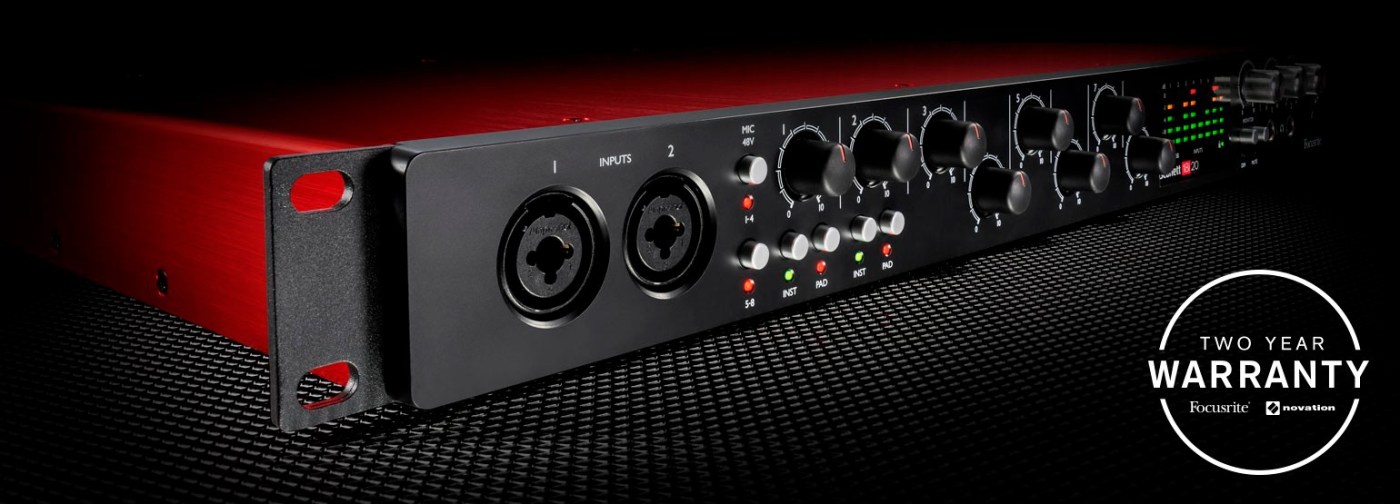
So adding a new multitrack USB interface was long overdue. Given the length of my shopping period and budget, I was pretty comfortable all around with the idea of the Focusrite Scarlett 18i20. The Scarlett line has been around for a while, now into its second generation, and the 18 input/20 output package was what I had in mind.
There are 8 analog XLR/combi jack inputs which will see the heaviest duty, as well as stereo S/PDIF and 8 ADAT via TOSLINK inputs, which present some nice expansion capabilities. I’m already thinking of a stereo channel strip with digital outs for the S/PDIF, and the ADAT inputs put plenty of live recording scenarios into reach.
In the Rack
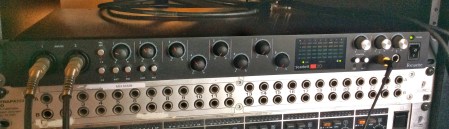 However, day-to-day it’s going to be sitting still in the tableside rack. And it’s there that silly little things that I should have anticipated rise glowingly to make this an amazing upgrade to not only sound quality, but also workflow. When you work alone, you don’t realize the roadblocks that a stereo interface throws up, because you’re generally spitting out only mono and stereo performances at any given time.
As you move from guitar to bass to vocals, however, you’re re-routing your inputs every time. So it’s obvious to everyone but me that 8 analog inputs are a game-changer. Me, nope, I had to watch the game actually change before the lightbulb came on.
First off, both the combi jacks on the front face of the 18i20 are Hi-Z, which obviously dedicates them to guitar and bass DI purposes. The quality of sound in Hi-Z mode is astonishing. A Strat plugged in directly is actually a usable sound, not simply a “sort of” sound to serve as a guide.
I don’t recall the last time I used a split feed on a bass, prior to the Focusrite’s appearance. A quick mono DI feed into a two-channel interface is just too invitingly lazy that I succumb every time. Now, however, with nothing to unplug first, setting up a stereo DI to deliver both direct and miked amp signals becomes a 10-second patch and, boom, the quality of the bass sound has another dimension.
Always On
My favourite mics are always plugged in. It’s just a matter of bringing up signal level and fiddling with position. No more settling for this mic because it’s plugged in rather than choosing another that requires rerouting.
A snake puts the XLR inputs right there, so when I do have to route something, I’m not working at the device level. Simple. And the sound… well, I’m still in the honeymoon period, but the clarity and low noise of the Scarlett preamps underscore how overdue this upgrade was.
Faster, better sound that’s always ready to go. My only complaint is that the scarlett surfaces of the Scarlett interface are all hidden in the rack. I suppose I can live with that.
-Scott.
London, Ontario 11/28/2017
 Shadow Factory
Leave a comment